Intuition?
People have been talking about intuition for thousands of years, but what actually is it?
Modern dictionary definitions of the term typically describe intuition as one of two processes:
- communication between human consciousness and a higher reality and the transcendent;
- human thought occurring without conscious awareness.
Some insist on one definition of the term, others on another, but this does not affect the existence of these processes.
And so the question arises — can intuition somehow be measured? Humanity still doesn't truly know what time is, yet it has successfully measured it for several thousand years; so why should intuition be any "worse"?
Mathematics?
Probability theory views "coin tossing" (or more precisely, a coin model) as a process where a coin never vanishes, never hangs suspended in mid-air, and never lands on its edge. The outcome of a coin toss is always definitive: it lands flat, either showing "heads" or "tails".
And no matter how small a number the experimenter comes up with, you can always flip a coin enough times so that the distance between the number 1 and the ratio of "number of heads / number of tails" turns out to be less than that chosen number.
Thus, no matter what you do — the more times you flip a coin, the closer the number of heads gets to the number of tails.
However, in real life, this often breaks down. Because a person stops after 3–5 heads in a row and fixes upon an undeniably interesting result.
And then, if you look at just this single session consisting of these 3–5 consecutive flips as a discrete experiment — everything is fine with mathematics.
But if such "sessions" occurred 10 times during the day, and the coin-tossing throughout the entire day is considered as a single isolated experiment — mathematics can no longer explain it.
Because the probability of such an event is vanishingly small.
Combining Them?
Capybara Intuition Lab explores the process of human decision-making under conditions of uncertainty.
A Session as a Discrete Experiment
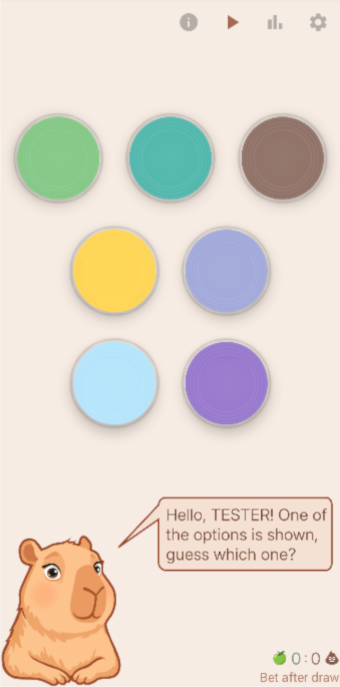
A session is treated as a standalone experiment. This represents your activity on the game screen.
When you switch to another screen or close the app, the session ends. When you return to the game screen, a new session is created.
Capybara Intuition Lab assumes that an individual session serves as a "gauge" of your current state:
- concentration;
- motivation;
- emotional state;
- and so on.
That is why sessions are intentionally treated as independent observations, and each carries equal analytical weight.
How the Game Works
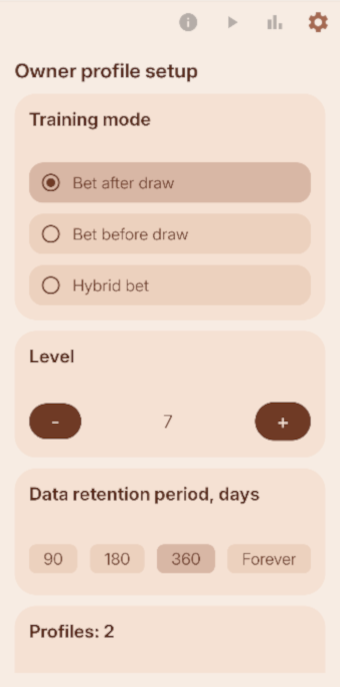
You independently choose how many buttons to play with during a session and in which mode.
The app makes its bet, and you make yours. If the bets match, the app registers a correct guess. If not, it's a miss.
Unlike this theoretical probability, the numerical performance metric for a session is simply the ratio of correct bets to all bets made during that session.
What the App Measures
The app provides the user with data regarding:
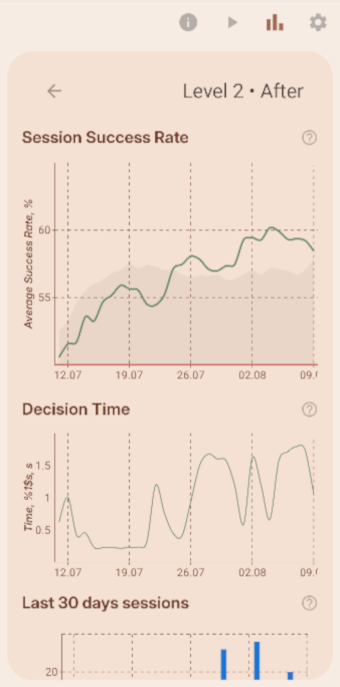
- the number of sessions played throughout the day;
- the average decision time per bet throughout the day;
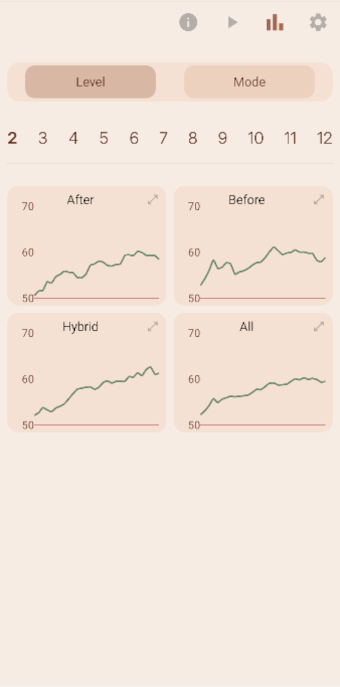
- the average success rate of sessions throughout the day.
The Randomness Corridor
In addition, the app analyzes and visualizes on charts a "corridor" around the mathematical probability line, which displays the range of result fluctuations that can still be explained by pure chance.
As long as your success curve stays within the corridor, your results remain within the margin of mathematical error.
But if that thick green curve breaks out of the corridor, your results become very difficult to explain through mathematics alone.
How to Understand This?
Capybara Intuition Lab does not promise to develop a "sixth sense" nor does it ask you to believe in supernatural abilities. At the same time, it does not deny their existence.
Capybara Intuition Lab invites you to observe how your results change over time, regardless of whether you practice meditation, consider yourself religious or a mystic, or if your worldview is built on chemical reagents, computers, and other attributes of modern science.
The core question of Capybara Intuition Lab is not:
«How well did I play?»
but rather:
«Is there something more than randomness in my results?»
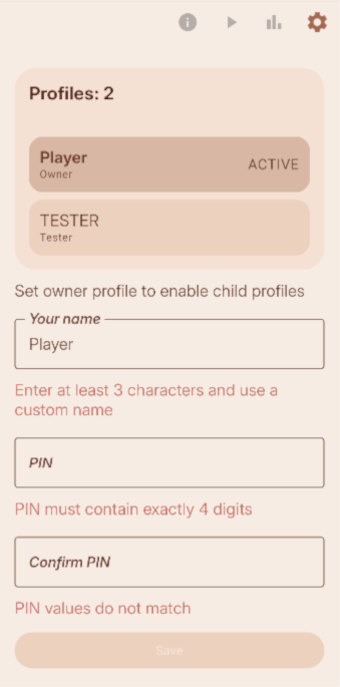
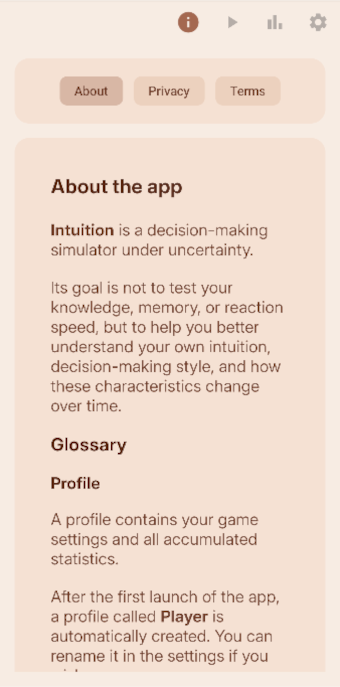
What Does It Look Like?
Intuition!
Perhaps intuition is thinking without conscious awareness, or perhaps it's communication with the transcendent.
And just like any skill, intuition can be developed.
Is Capybara Intuition Lab suitable for this? — Yes, and our mascot, the Capybara, not only supports you during your practice sessions but also offers plenty of interesting tips on developing your intuition.
Is Capybara Intuition Lab better than other trainers? — That's for you to decide.
Intuition without verification and mindful observation of its acts remains a fleeting sensation.
But verified intuition, conscious intuition, becomes a genuine tool for a feeling and thinking human being.
Contact
Email: ideas@capybara-soft.com